
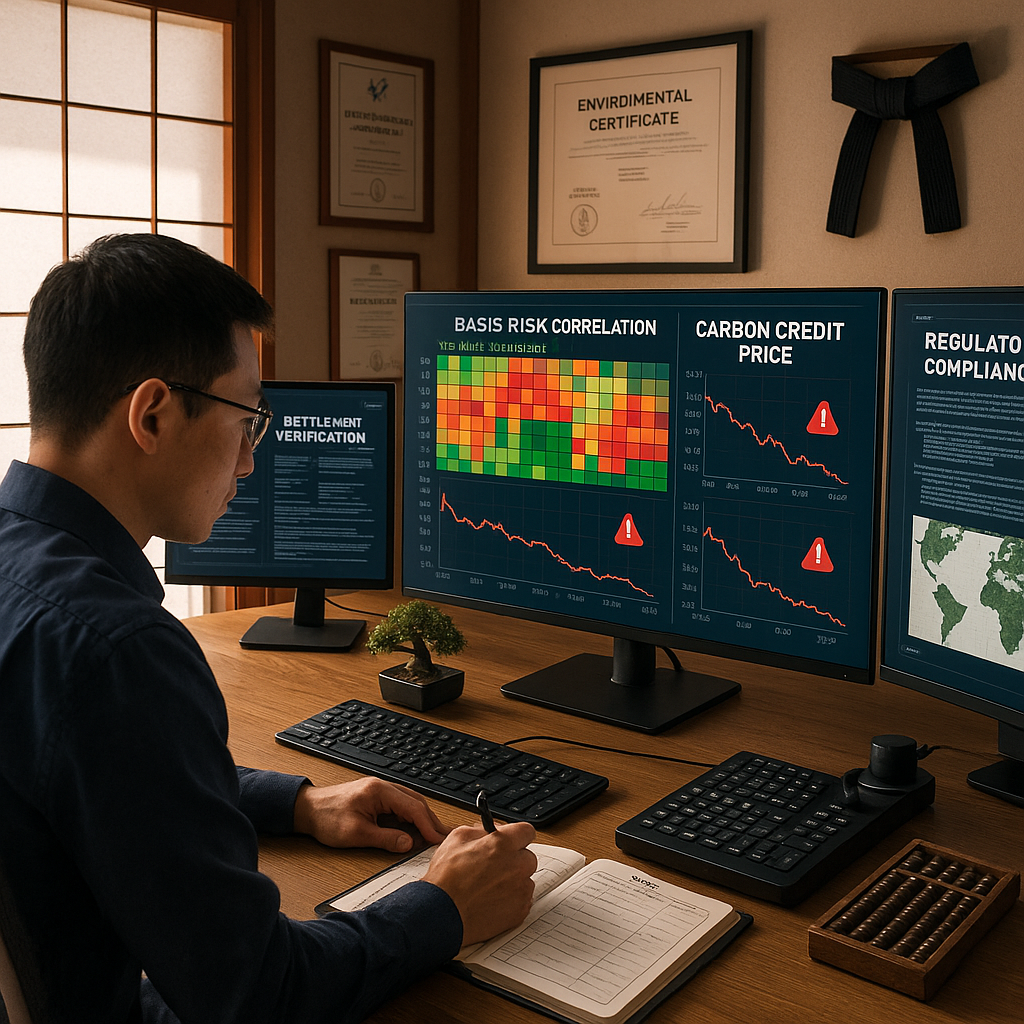
Key Takeaways
Navigating environmental trading requires both technical skill and an unwaveringly disciplined mindset. Mistakes in this domain can erode hard-won profits and compromise your mission, particularly when risks and cognitive biases are underestimated or ignored. The following key principles reveal the most common and costly errors in environmental trading. They’ll equip you to avoid these pitfalls with mastery, integrity, and resilience.
- Respect basis risk by knowing your market’s true exposures: Underestimating or overlooking basis risk often leads to surprises and unexpected losses. Always analyze the specific correlation between your instruments and the underlying asset, ensuring your hedge truly aligns with your actual exposure.
- Demand absolute settlement clarity before entering trades: Unclear settlement processes or ambiguous contract terms can lead to disputes, delays, and cash flow challenges. Confirm every detail, from delivery timeline and pricing to verification requirements, before executing a trade.
- Challenge overconfidence and embrace rigorous self-assessment: Overestimating your skill, especially with complex or emerging environmental products, can amplify losses. Routinely review your past trades, seek outside feedback, and actively question your market assumptions to safeguard against self-sabotage.
- Prioritize liquidity to avoid getting trapped in thin markets: Trading illiquid products can quickly turn a winning setup into a losing position due to wide bid-ask spreads and slow executions. Always assess the depth of the order book and true trade volume before committing significant capital.
- Hold yourself to uncompromising ethical standards: Though shortcuts may offer brief advantages, they undermine trust and can invite regulatory scrutiny. Stay transparent, fair, and ethical in every transaction to safeguard your reputation and long-term standing.
- Use structured checklists to catch blind spots: Organizing your trading process in a clear, repeatable checklist helps reduce oversight and ensures consistency. Systematic routines help you catch common errors before they escalate into costly problems.
- Master continuous learning. Review and adapt after every trade: Environmental markets evolve quickly. Debrief each trade, identify repeat missteps, and implement lessons learned to foster resilience, adaptability, and long-term self-mastery.
Success in environmental trading is not about achieving perfection. It’s about maintaining structured awareness, rigorous discipline, and the humility to adapt. In the sections that follow, we’ll examine each of these mistakes in detail and arm you with battle-tested strategies to sharpen your competitive edge.
Introduction
The world of environmental trading is shaped by fine margins and relentless complexity. A single overlooked detail, such as an unexamined basis risk, a poorly defined settlement provision, or unchecked overconfidence, can quietly undo months of diligent effort. These errors strike not only at profits, but also threaten to undermine the environmental mission that motivates so many to trade in this space.
Success belongs to those who approach these markets with equal parts technical expertise and principled discipline. By understanding common missteps and cultivating a structured decision-making process, you strengthen your ability to withstand volatility and uphold your integrity. Let’s explore the major pitfalls and forge a path to trading with clarity, discipline, and enduring confidence.
Stay Sharp. Stay Ahead.
Join our Telegram Channel for exclusive content, real insights,
engage with us and other members and get access to
insider updates, early news and top insights.
 Join the Channel
The Hidden Cost of Basis Risk
Basis risk is one of the most insidious threats in environmental trading. It emerges from discrepancies between the price of an environmental asset in one market and its value in another, and is exacerbated by the lack of standardization across these specialized markets. When left unaddressed, basis risk can erode profits regardless of the overall direction of the market.
Understanding Basis Risk in Environmental Markets
Environmental assets introduce basis risk in several distinctive ways:
- Geographic basis risk: Prices vary due to regional differences. For example, California Carbon Allowances versus EU Emission Trading System credits can diverge based on local regulations or infrastructure.
- Quality basis risk: Different project types or asset qualities (such as forest-based carbon credits versus renewable energy certificates) command different premiums, often unpredictably.
- Temporal basis risk: The evolving nature of environmental regulations means that spot and forward prices may decouple, especially if future compliance rules are uncertain or shifting.
A report from the International Emissions Trading Association found that during 2021, cross-border carbon trades experienced an average of 15-20% price volatility due to basis risk alone. This really underscores the high stakes in this often-overlooked area.
Real-World Examples Across Industries
- Investment Funds: In 2022, Greenfield Investments established a large position in voluntary carbon offsets and hedged with compliance market futures. When regulatory news affected these two markets differently, the assumed correlation broke down and the firm faced multimillion-dollar unrealized losses.
- Renewable Energy Traders: During a 2021 California heatwave, RECs in the Western US traded at a massive premium compared to PJM market RECs. Traders who had relied on historically stable price relationships between these markets faced unexpected losses.
- Commodity Producers: Companies hedging environmental attributes alongside traditional commodities (such as an oil & gas producer managing both fuel and carbon market exposures) often see traditional hedges fail to cover evolving regulatory basis risks, leading to wide P&L swings.
Strategies to Mitigate Basis Risk
To manage this complexity, adopt the following best practices:
- Develop asset-specific correlation matrices: Continuously track historical price relationships and update your analysis as markets evolve. Quantitative metrics such as R-squared help assess strength of correlation.
- Implement defined basis risk limits: Set strict thresholds for maximum allowable exposure to basis risk, informed by historic worst-case scenarios.
- Leverage natural hedges: Where possible, align contract specifications closely with your underlying exposures. This reduces the risk of market dislocations impacting your hedge’s effectiveness.
- Run scenario and stress tests: Model regulatory changes, policy shifts, or market disruptions to anticipate how basis risk might respond in extreme cases.
Properly assessing and managing basis risk requires a disciplined and systematic approach. Getting this right has ripple effects. It can strengthen your ability to master additional market uncertainties, like those found in settlement processes.
Settlement Uncertainty
Settlement in environmental markets brings a host of unique challenges, often overlooked by traders accustomed to more standardized asset classes. Environmental assets require not only the transfer of value, but also compliance with verification processes, regulatory approvals, and project-level requirements that can all introduce uncertainty.
Key Settlement Terms in Environmental Trading
When structuring or reviewing an environmental trade, focus meticulously on:
- Delivery mechanisms: Specify whether transfer is physical or financial, including registry and account details.
- Verification protocols: Most environmental trades require independent validation before settlement. Confirm the details upfront.
- Regulatory acceptance: Ensure that credits, allowances, or certificates are recognized and authorized for your intended purpose.
- Vintage and origin: The year and source of generation can dramatically alter market value and compliance eligibility.
- Additionality documentation: Validate that the project genuinely yields new or incremental environmental benefit.
- Retirement and end-use rights: Clarify whether and how credits can be retired for compliance or voluntary claims.
A recent Environmental Finance survey reported that 42% of environmental traders experienced settlement disruptions, with two-thirds of these incidents leading directly to substantial financial losses.
Common Settlement Disputes and Industry Examples
- Project Delays: In 2022, a financial institution paid for reforestation credits scheduled for Q3 delivery. Verification delays held up settlement by four months, forcing the buyer to procure alternative credits at a significant premium to meet mandatory reporting deadlines. A lack of explicit remediation terms in the contract magnified the financial impact.
- Quality Specification Confusion: A renewable energy company purchased California solar RECs, but received certificates from another qualifying project type, valued at 15% less. The contract’s vague definition of “acceptable assets” led to an expensive, time-consuming dispute.
- Healthcare Systems: Hospital networks purchasing renewable energy for sustainability targets have encountered delays and disputes when credits failed late-stage regulatory review.
- Large Corporates: Multinational consumer brands aiming for carbon neutrality have faced public relations challenges and financial hits when settlement issues delayed credit retirements or revealed project verification gaps.
Creating a Settlement Verification Framework
To minimize operational and financial risk, apply this comprehensive process:
- Pre-trade diligence: Confirm counterparty reputation, registry access, and project verification status. Ensure the asset’s eligibility for your compliance or voluntary use case.
- Precise contract drafting: Set clear, milestone-based timelines for verification and transfer. Detail quality parameters, vintage, and geographic limits for all deliverables.
- Quantify settlement risks: Calculate the financial and compliance impact of potential delays or failures. Set up appropriate collateral and clear remedies for non-performance.
- Contingency protocols: Identify backup suppliers, monitor progress with early warning triggers, and establish dispute resolution mechanisms in advance.
Through disciplined pre-trade assessment and robust contract design, traders can navigate the complex settlement landscape while maintaining flexibility. However, even the best risk management process can be undercut by human fallibility, particularly the trap of overconfidence, to which we now turn our attention.
Combating Overconfidence Bias
Overconfidence can quietly destabilize even the most methodical trading process. Particularly in nuanced and shifting markets like environmental products, early wins or technical expertise may create a dangerous illusion of control, inviting complacency in risk management.
The Confidence Trap in Environmental Trading
Overconfidence tends to surface in several distinct ways in these markets:
- Regulatory Forecasting: Believing you can reliably predict policy or compliance trends creates blind spots, despite a long history of regulatory surprises and rapid market pivots.
- Technical Analysis Overreach: Applying classic technical analysis to thinly traded or structurally unique products can give false signals that traders over-trust.
- Sector Knowledge Confusion: Scientific or regulatory expertise does not directly translate to superior trading skills. The markets reward disciplined process, not just subject matter knowledge.
- Amplified Success Narratives: Fresher traders often mistake a handful of wins (attributable to market conditions or luck) for a repeatable edge, leading to outsized confidence and risk exposure.
Studies published in the Journal of Behavioral Finance found overconfidence levels among environmental traders were more than a third higher than professionals trading more established asset classes. That’s a direct threat to measured judgment.
Practical Self-Assessment for Overconfidence
Use the following diagnostic to spot the warning signs within your own approach:
- Position Sizing: Are trades in environmental products consistently larger than your average trade? Have you increased size strictly in response to recent wins?
- Research Balance: Do you prepare more thoroughly for favorable scenarios than adverse ones? Do you routinely seek dissenting views or challenge your thesis?
- Certainty Quotient: Are you setting very high (over 80%) outcome probabilities without strong justification? Are you prematurely using unrealized profits or incurring debt on future gains?
- Win Rate Illusion: Does your mental record of “wins” exceed documented results? Do you attribute setbacks only to uncontrollable events, rather than possible flaws in your process?
If you identify frequent “yes” responses, especially across multiple categories, overconfidence may be quietly shaping your decisions and blunting your discipline.
A Disciplined Framework to Counter Overconfidence
To maintain clarity and self-mastery in the face of complex markets, implement these practices:
Stay Sharp. Stay Ahead.
Join our Telegram Channel for exclusive content, real insights,
engage with us and other members and get access to
insider updates, early news and top insights.
Join the Channel
- Documented Pre-Trade Rationale: Record your thesis, what could disprove it, and choose position size based on maximum loss scenarios, not optimistic projections.
- Trading Journal with Confidence Ratings: Capture your confidence before each trade and revisit after, learning from both successes and errors. Invite a mentor or peer to periodically critique your entries.
- Regular, Dedicated Bias Reviews: Set scheduled check-ins (at least quarterly) focused solely on surfacing and addressing overconfidence. Use hard data, such as win rates, drawdowns, and error patterns, to ensure perception matches reality.
Through rigorous self-examination and the humility to adapt, you can maintain the discipline necessary to thrive in these high-stakes markets.
Conclusion
Sustained performance in environmental trading demands more than technical proficiency. It requires vigilant risk management, airtight verification of every settlement, and, most importantly, honest self-reflection. Basis risk and settlement uncertainties introduce complexities that can erode even the best-designed strategies in markets defined by volatile price relationships and shifting regulatory frameworks.
Yet the most persistent threats often arise from within. Overconfidence, undetected or unchecked, can unravel carefully laid risk controls. Only traders who consistently review their process, measure their own biases, and remain committed to disciplined routines can adapt and thrive as environmental markets evolve.
Looking forward, the next generation of environmental trading leaders will be those who unite technical expertise with a spirit of continuous learning and self-mastery. In a landscape where regulations, technologies, and global priorities are in constant flux, agility and structured discipline offer the true edge. The challenge is not only to avoid the obvious pitfalls, but to build a trading practice rooted in resilience, transparency, and humility. This is the true way of the market warrior. Mastery that endures well beyond fleeting market cycles.




Leave a Reply