
Key Takeaways
-
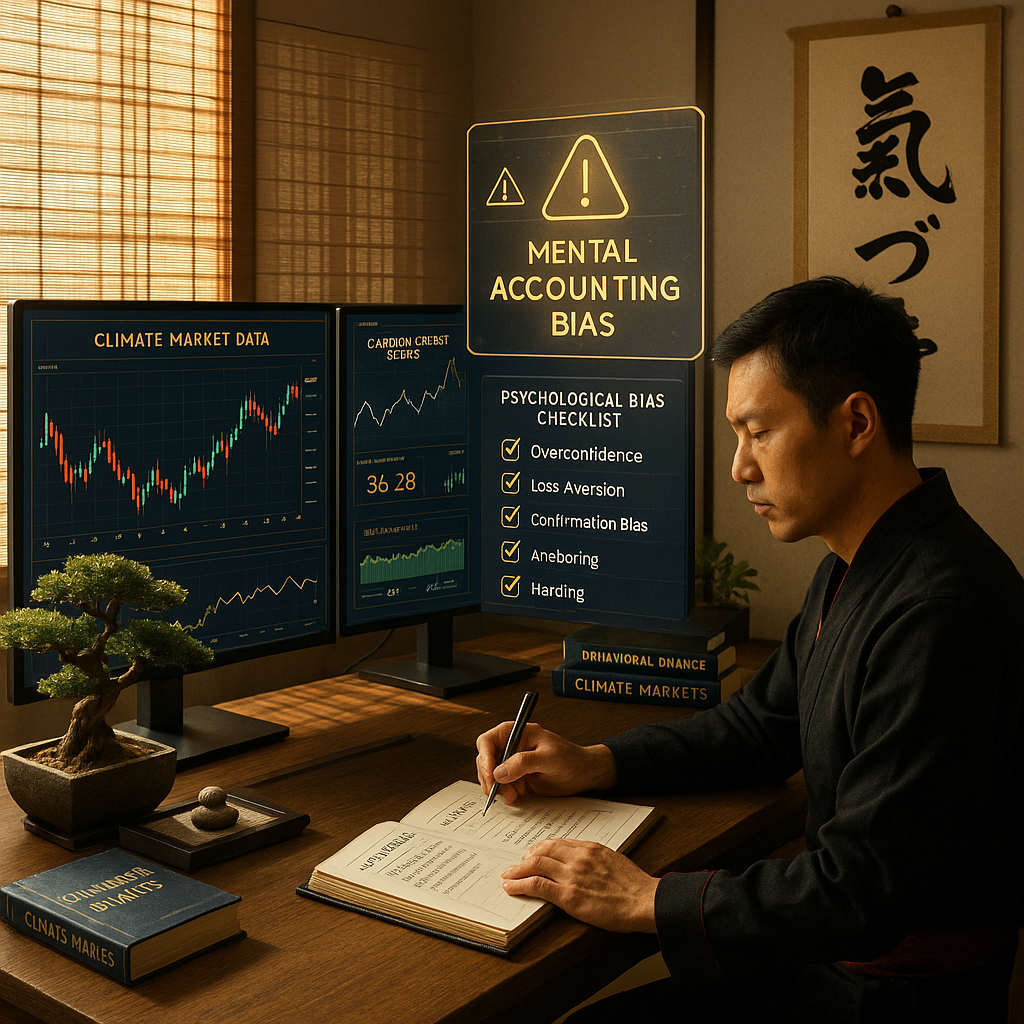
Cognitive biases exert a powerful influence in climate trading, shaping risk assessment, trade execution, and portfolio outcomes in ways that often escape conscious notice. Recognizing how cognitive patterns like mental accounting, overconfidence, and anchoring affect your decisions is essential for constructing strategies that are disciplined, resilient, and able to withstand market and psychological turbulence. Mastering these insights will enable you to identify, address, and apply behavioral finance principles for robust bias management within climate trading.
-
Guard against mental accounting traps that undermine your trading discipline. Many traders mentally segment gains and losses, treating different climate assets as isolated “accounts.” This fragmented approach leads to irrational risk-taking and premature or delayed trade exits, ultimately reducing the effectiveness of climate-focused portfolios.
-
Challenge overconfidence by scrutinizing conviction versus accuracy. The allure of certainty can blind traders to inherent climate market risks and prompt overleveraged positions. Consistent self-review and external feedback are critical for rooting your decision-making in reality, not just in belief.
-
Stay wary of anchoring to outdated assumptions in a rapidly changing landscape. Initial data points, such as historical carbon prices or legacy weather models, can create mental “anchors” that skew expectations and hinder adaptation as new information surfaces. Actively updating your frameworks encourages more adaptive and precise trading decisions.
-
Behavioral finance offers a window into hidden drivers of climate trading errors. Integrating behavioral insight into your strategy sheds light on predictable missteps, allowing you to anticipate market moves shaped by crowd psychology or shifting narrative trends in climate finance.
-
Strong bias management routines sharpen your trading discipline. Structured self-audits, checklists, and reflective journaling retrain your mental habits, cultivating self-mastery and bolstering resilience against recurring cognitive traps.
-
Cultivate a mindset of continuous learning to adapt and stay ahead of market biases. Embracing relentless growth empowers you to refine your strategies as climate markets (and the human behaviors within them) evolve faster than static assumptions can accommodate.
By developing the discipline to recognize and skillfully manage cognitive bias, you shift from reactive, emotionally-driven trading to a methodical, strategic approach grounded in self-awareness. The next sections will present actionable techniques to identify, neutralize, and strategically leverage these biases. This sets you on course for greater consistency and long-term success in climate trading.
Introduction
Every climate trade is shaped by unseen influences: your own cognitive biases. Even experienced traders can fall into patterns like mental accounting, overconfidence, and anchoring to outdated frameworks, guiding judgment in subtle but consequential ways. These psychological factors impact not just how risk is perceived, but also when and why trades are executed, and at what point portfolios are adjusted.
Grasping and managing these biases transcends theoretical knowledge; it is a practical necessity for building strategies that stand strong amid market volatility and emotional impulses. Behavioral finance brings these hidden influences into the open and provides actionable tools to navigate their effects with clarity and discipline. As you enhance your awareness of these cognitive traps, you elevate your capacity for strategic decision-making and self-mastery in climate markets.
The Role of Cognitive Biases in Climate Trading
Climate trading stands among the most intricate and fast-evolving markets today, blending conventional financial mechanics with complex environmental data and policy considerations. This fusion creates the perfect environment for cognitive biases to thrive. In practice, cognitive biases are systematic deviations from rational judgment, and their influence in climate markets can distort everything from risk calculations to asset pricing and portfolio allocation.
Stay Sharp. Stay Ahead.
Join our Telegram Channel for exclusive content, real insights,
engage with us and other members and get access to
insider updates, early news and top insights.
 Join the Channel
Behavioral finance merges psychological science with economic models to explain how real traders, not just theoretical “rational agents,” make decisions. Climate markets bring heightened susceptibility to these distortions due to:
- Long Investment Horizons: Climate-centric assets often require making projections over decades, increasing uncertainty and making intuitive errors in valuation more likely.
- Technical and Scientific Complexity: Traders must decipher intricate data, juggling scientific research and financial metrics within their decision-making processes.
- Changing Regulatory Contexts: Policy shifts can dramatically alter risk profiles and opportunities, demanding constant vigilance and adaptability.
- Blended Value Goals: Climate trading often involves balancing financial objectives with environmental impact considerations, introducing competing motivations.
These dynamics create what behavioral economists call “decision environments of high complexity and uncertainty.” In such settings, cognitive biases tend to amplify. For example, when carbon credits exhibit volatile price swings, traders often connect events to internal narratives instead of relying on an unbiased analysis of broader market and policy changes.
The consequences of unchecked cognitive bias are significant. The Climate Finance Initiative’s studies reveal institutional investors frequently underprice climate risk while overestimating their ability to foresee market shifts. This gap leads to pricing inefficiencies, subpar portfolio results, and an accumulation of systemic risk across the climate asset universe.
Recognizing and mastering these biases is more than a theoretical edge. It provides a concrete trading advantage. Market leaders who deliberately adjust for psychological pitfalls gain what Daniel Kahneman describes as “a distinctive edge” in challenging market climates. Nowhere is this more pronounced than in climate trading, where evolving science, regulatory uncertainty, and behavioral herd dynamics set the stage for remarkable opportunities and risks.
With this understanding, it becomes clear that each cognitive bias can serve as either an obstacle or a source of differentiation, depending on how it is managed. Let’s examine and address the nuances of specific biases, beginning with mental accounting, in the context of climate trading.
Mental Accounting in Climate Portfolios
Mental accounting, a concept formalized by Richard Thaler, describes how people subjectively label and evaluate different types of money or investments, often ignoring the broader economic reality. In climate trading, such cognitive compartmentalization leads to inefficiencies and misaligned risk management.
How Mental Accounting Distorts Climate Trading Decisions
In practice, climate traders might classify renewable energy equities, carbon credits, and adaptation assets as discrete “buckets,” each with its own risk tolerance and return expectations. This separation is not rooted in portfolio theory, but psychological preference, and it has several adverse effects:
- Fragmented Risk Evaluation: Evaluating each asset “account” in isolation prevents traders from understanding portfolio-wide risk exposures, potentially missing hidden correlations that intensify losses during systemic market events.
- Inconsistent Return Benchmarks: Traders often apply double standards, tolerating mediocre returns in some climate assets due to perceived “importance,” while demanding outsized gains elsewhere, regardless of actual risk-return dynamics.
- Uneven Loss Aversion: Some assets are cut at minor losses while others are held unrealistically long, purely due to their assigned mental category.
Case Example: Mental Accounting in Carbon Credit Trading
Consider the experience of a mid-sized hedge fund in the environmental asset sector. Portfolio managers classified compliance carbon credits as “safe,” maintaining large positions and minimal downside review, while viewing voluntary credits as “risky” and applying stringent stop-loss policies.
When regulatory winds shifted, compliance markets suffered unexpected setbacks and the fund clung to these “safe” assets, incurring steep losses. Simultaneously, they exited voluntary credits prematurely, despite market improvements, due to their “risky” designation. This artificial separation led to a 32 percent underperformance relative to peers that used a more integrated risk approach.
Practical Solutions for Mental Accounting
Combating mental accounting requires systematized practices:
- Centralized Portfolio Analytics: Leverage portfolio management platforms that aggregate all climate assets on a single dashboard for comprehensive risk and return visibility.
- Objective Performance Benchmarks: Apply uniform evaluation standards and performance benchmarks across all climate holdings, regardless of label.
- Holistic Risk Reviews: Regularly conduct reviews to assess asset class interdependencies and systemic responses to market shocks.
- Rotational Analysis Duties: Assign analysts to rotate across asset types, broadening perspective and reducing psychological bias to specific segments.
- Fungibility Mindset Training: Routinely question, “If starting from scratch, would I re-enter each position at today’s prices?” If the answer is no, unbiased rebalancing is warranted.
Mental accounting’s tendency to compartmentalize and ignore interconnection leads to mispricing and missed risks. Overcoming it requires conscious integration. View the climate portfolio as one dynamic system rather than disconnected clusters. This level of discipline is essential for consistent performance and strategic adaptation.
Transcending mental compartmentalization in climate investing enhances cognitive discipline. It also prepares traders for the next psychological hurdle: overconfidence.
Overconfidence Bias in Climate Market Analysis
Overconfidence bias, the overestimation of one’s knowledge and predictive ability, is especially menacing in climate markets due to their scientific complexity and unpredictably shifting rule sets. This bias manifests in a few distinct forms that, if ignored, can undermine even the most sophisticated trading strategies.
Overconfidence Types Common in Climate Trading
- Predictive Overconfidence: Excessive belief in one’s ability to forecast policy moves, technology shifts, or long-term price trends in climate-linked markets.
- Knowledge Overconfidence: An inflated sense of understanding regarding the nuances of environmental science, regulatory developments, or novel asset structures.
- Control Overconfidence: The mistaken notion that one can actively manage or sidestep all downside risks through superior skill or timing.
Research from the Behavioral Climate Finance Group supports the prevalence of overconfidence: over three-quarters of active traders believe their models are more accurate than their peers—a statistical impossibility. This inflated self-assurance shows up in organizational behavior and individual trades alike:
- Oversized Trades: Basing large trades on unwarranted confidence in specific forecasts.
- Lax Hedging: Underpreparing for adverse events by underutilizing risk mitigation tools.
- Overtrading: Increasing transaction frequency, convinced of rare market insight.
- Confirmation Bias: Filtering out contrary evidence in favor of self-affirming data.
Illustration: California Carbon Allowance Market
During the California Carbon Allowances (CCA) integration with Quebec, many trading desks relied on historical models with high faith in predicted reactions. Their models, though backtested, did not anticipate new market mechanics and interconnected volatility. Overconfident players suffered outsized losses during this structural shift, while teams that regularly challenged assumptions and stress-tested their scenarios endured less volatility and more stable results.
Specifically, teams employing “devil’s advocate” reviews and scenario diversifications saw a 40 percent reduction in return volatility amid the upheaval, compared to those sticking doggedly to prior models and centralized assumptions. This case makes plain that structured humility and risk awareness provide tangible resilience.
Stay Sharp. Stay Ahead.
Join our Telegram Channel for exclusive content, real insights,
engage with us and other members and get access to
insider updates, early news and top insights.
Join the Channel
Robust Practices to Correct Overconfidence
To moderate overconfidence, successful climate traders deploy thoughtful routines:
- Confidence Calibration: Regularly evaluate forecasts against true outcomes to shape realistic self-awareness about predictive limits.
- Premortem Analysis: Habitually ask, “What could cause this trade or model to fail?” and document plausible pitfalls.
- Red Team Reviews: Assign responsibility for formally challenging major theses or assumptions in every new strategy.
- Scenario Expansion: Explicitly consider wider ranges of both typical and atypical outcomes; frequently review and update as new data emerges.
- Objective Feedback Loops: Maintain relationships with independent specialists (whether scientists or policymakers) who can offer unvarnished reviews of your assumptions.
- Surprise Journaling: Keep a “market surprise” log. When actual events contradict forecasts, record the lessons and incorporate them into future analyses.
Cultivating appropriate confidence is an ongoing process. By continually auditing assumptions, soliciting dissent, and grounding every decision in objective feedback, climate traders can merge conviction with realism. This blend forges a mindset equipped to adapt, endure, and ultimately capitalize on the changing terrain of climate finance.
Conclusion
Excelling in climate trading calls for more than expert knowledge of markets or assets; it demands deep psychological discipline and the humility to identify and override your own biases. As shown, cognitive pitfalls like mental accounting and overconfidence have the power to quietly distort outcomes in markets marked by scientific uncertainty and shifting rules. Yet, traders who bring structure to self-analysis (integrating portfolio-wide reviews, confidence calibration, and behavioral audits) convert these challenges into a sustainable competitive edge.
In an environment where uncertainty is the norm and the tempo of change accelerates, victory belongs to those who train their minds as rigorously as they study the market. The most successful traders will master both external strategy and internal awareness, forging portfolios and mindsets resilient enough to weather not only the next wave of volatility but the relentless evolution of climate finance itself.
Looking ahead, those who foster discipline, engage in relentless learning, and welcome honest feedback will not only sidestep the hazards of bias. They will shape the future of climate trading, thriving in an arena where adaptability and self-mastery are the ultimate trading edge. The real opportunity is not simply to react to change, but to anticipate it and emerge as a leader in a landscape where psychological discipline defines lasting success.



Leave a Reply