

Key Takeaways
- Trader discipline faces its greatest test in the highly volatile and specialized realms of weather derivatives and water futures. This Q&A investigates the daily habits, stress management strategies, and mindset shifts empowering traders to thrive amid climate uncertainty and relentless market pressure.
- Discipline forms the cornerstone of trading resilience. Consistent routines, clear rule-sets, and meticulous journaling help traders maintain objectivity and emotional control, even when weather-driven markets defy standard predictions.
- Effective stress management arises from structured routines and self-mastery. Leading traders integrate meditation, regular breaks, and post-session debriefs to process losses, reset focus, and prevent impulsive decisions during periods of heightened volatility.
- The complexity of climate markets demands relentless learning. Achieving success in weather derivatives and water futures requires ongoing study of meteorology, regional regulations, and hydrological data, enabling traders to anticipate risks and spot emerging opportunities.
- Robust risk management is essential in niche markets. Tools such as exposure limits, scenario mapping, and diversified positions are fundamental for capital protection, defending against both market-driven and environmental shocks.
- Community and mentorship catalyze progress. Consistent knowledge sharing with experienced peers (covering strategies, market reads, and lessons from setbacks) help traders refine approaches and stay adaptive in a field defined by rapid evolution.
- Self-awareness fuels transformation. The highest-performing traders objectively reflect on mistakes, track psychological triggers, and adjust strategies to enhance both performance and mental well-being, ultimately turning market adversity into personal and strategic growth.
Introduction
In markets shaped by storms, droughts, and the unyielding pulse of climate news, trading discipline stands as both armor and weapon. Few arenas test a trader’s resolve like the unpredictable world of weather derivatives and water futures, where clarity must emerge from chaos and nature, not just economics, dictates the rules.
This Q&A unveils the daily rituals, stress management techniques, and mindset frameworks that distinguish successful traders in these high-pressure climate markets. Readers will gain practical insight into staying disciplined under duress, managing volatility, and navigating risk (all informed by the real experiences of professionals who build resilience in the face of uncertainty). Step into The Trading Dojo, where seasoned traders share how discipline can transform every market challenge into an opportunity for mastery.
Understanding Weather Derivatives and Water Futures Markets
Market Fundamentals and Structures
Weather derivatives and water futures stand as specialized sectors in the financial landscape, requiring unique expertise and approaches. Unlike traditional asset classes, these instruments are driven by environmental forces that significantly influence pricing and volatility.
Weather derivatives empower organizations to hedge against adverse weather events. Rather than being tied to financial assets, these contracts are valued based on weather indices such as temperature, rainfall, snowfall, or wind speed. For instance, the Chicago Mercantile Exchange (CME) lists standardized contracts built on Heating Degree Days (HDDs) and Cooling Degree Days (CDDs) for key cities, establishing the backbone for this unique market.
Stay Sharp. Stay Ahead.
Join our Telegram Channel for exclusive content, real insights,
engage with us and other members and get access to
insider updates, early news and top insights.
 Join the Channel
Key market structure elements include:
- Settlement values derived from objective meteorological data sources
- Contract types ranging from futures, options, to swaps with varying durations (weekly, monthly, seasonal)
- Diverse market participants (energy and agricultural companies, insurers, and specialist trading entities)
- Price determination rooted in climate forecasts, historical weather trends, and seasonal shifts
Water futures have emerged as a response to escalating water scarcity and price volatility. Launched by the CME through the Nasdaq Veles California Water Index futures in December 2020, these contracts allow market players to hedge or gain exposure to fluctuations in California’s spot water market.
“Weather and water markets represent the intersection of environmental reality and financial innovation,” observes veteran trader James Morrison. “Unlike standard markets that react to economic news, these derivatives respond to complex climate patterns and regulatory frameworks that demand a specialized and evolving knowledge base.”
These markets also maintain relatively low correlation with broader financial markets. This independence introduces both diversification benefits and unique challenges, requiring traders to approach analysis and risk management with exceptional discipline.
Unique Challenges and Opportunities in Climate Risk Markets
Navigating weather derivatives and water futures involves distinct complexities that differentiate these markets from more conventional trading environments. The unpredictability of weather events and the accelerating impact of climate change intensify volatility, often disrupting historical norms and price models.
Major challenges include:
- Data Volume and Complexity: Successful trading demands synthesis of extensive meteorological, hydrological, and financial data.
- Model Uncertainty: Even advanced weather prediction models can have significant error ranges.
- Liquidity Constraints: These markets may exhibit lower liquidity, amplifying price swings and entry/exit challenges.
- Evolving Regulations: Regulatory landscapes shift rapidly, shaping market access, acceptable practices, and risk exposure.
- Geographical Nuance: Localized weather patterns and region-specific regulations necessitate tailored approaches.
Yet, for traders with discipline and specialized expertise, climate risk markets present compelling opportunities. Rising climate awareness across industries has expanded demand for hedging solutions, creating new counterparties and deepening liquidity over time. Sector-specific impacts (for example, the effects of drought on agriculture, or heat waves on energy demand) further increase potential for strategic advantage.
Dr. Sandra Chen, a climate market specialist, highlights this point: “The most successful traders in these markets build cross-disciplinary expertise that fuses meteorology, hydrology, and financial insight. The demand for such integrated knowledge creates a higher barrier to entry, rewarding those who commit to continuous education and improvement.”
Key knowledge areas for successful climate risk traders include:
- Grasp of climate science fundamentals and real-time weather systems
- Awareness of regionally specific regulatory structures and water rights
- Sectoral insights into how environmental factors impact energy, agriculture, finance, and even insurance industries
- Use of advanced forecasting models and scenario-based statistical analysis
This expertise gap enables dedicated, disciplined traders to develop a genuine edge. With the rapid evolution of environmental science and market structure, the commitment to mastery (central to The Trading Dojo’s philosophy) is a clear pathway to adaptability and long-term success.
Discipline Practices for Specialized Market Trading
Establishing Structured Analysis Frameworks
Outstanding results in climate risk trading do not arise from intuition alone; they depend on rigorous and systematic analytical frameworks. The most proficient traders in weather derivatives and water futures develop clear processes that blend multi-source environmental data with disciplined financial analysis.
A robust analytical framework should incorporate:
1. Integrated Data Sources
- Real-time weather/hydrological dashboards (e.g., NOAA, ECMWF updates)
- Reports from regional water authorities and government agencies
- Seasonal historical deviations and climate cycle analysis
- Multiple forecasting model crosschecks to counteract confirmation bias
2. Probability-Driven Scenario Analysis
- Mapping high-, medium-, and low-probability climate scenarios
- Quantifying market impact for each scenario
- Evaluating cross-asset correlations with related sectors (agriculture, energy, insurance)
- Stress-testing by modeling extreme environmental events
3. Timeframe Segmentation
- Short-term outlooks (hours to a week): responding to immediate weather developments
- Medium-term (one week to a month): monitoring emerging systems and shifting probabilities
- Long-term (weeks to seasons): interpreting larger climate cycles and policy changes
Marcus Williams, a seasoned water futures trader, illustrates the importance of discipline: “My process includes a daily review of three independent meteorological models, careful study of the latest California water authority allocations, and continuous scenario analysis before any position decision. This structure prevents reacting emotionally to every forecast headline.”
Stay Sharp. Stay Ahead.
Join our Telegram Channel for exclusive content, real insights,
engage with us and other members and get access to
insider updates, early news and top insights.
Join the Channel
This disciplined adherence to structured frameworks distinguishes leading traders from those who act impulsively. Clear, repeatable analysis builds a foundation for consistently wise decision-making, even in the face of the marketplace’s most chaotic periods.
Daily Routines and Practices of Successful Climate Risk Traders
Examining the daily routines of resilient traders reveals common patterns rooted in structure, reflection, and deliberate decision-making. These routines become a protective scaffold, enabling calm and consistent performance amid fast-moving market events.
Key daily practices include:
Morning Preparation
- Analyze fresh overnight weather updates from leading global and regional models
- Compare current data against historical events and analogues
- Review water reservoir metrics and regulatory reports
- Refresh real-time risk calculations on current positions
Integrated Data Review
- Cross-examine meteorological forecasts from multiple reliable sources
- Track relevant regulatory developments and upcoming policy changes
- Analyze price action in related commodities (grains, energy, insurance-linked securities) for early signals
- Document updated forecasts and their implications for strategy
Decision Execution
- Rely strictly on pre-established entry and exit parameters tied to forecast confidence
- Scale position sizes in relation to quantified volatility and scenario likelihoods
- Record the rationale and logic behind every trade before execution
- Continuously reassess open positions as new forecast data becomes available
Elena Kowalski, an active trader in California water futures, urges discipline: “I segment my day into dedicated time blocks for research, analysis, and decision-making. This prevents knee-jerk reactions to breaking news and helps maintain my analytical objectivity. Every time I bypass my routine, results suffer.”
Maintaining these habits reduces mental fatigue and frees bandwidth for deeper assessment of unexpected shifts. It also fosters the self-awareness necessary to learn from errors, adapt strategies, and continually improve (a core value at The Trading Dojo).
Alan Jacobs, a veteran weather derivatives trader, underscores this point. “The strength of your morning routine directly shapes trading outcomes. Hasty shortcuts invite mistakes and erode profitability. In these markets, the costs of inconsistent discipline quickly compound.”
These practices showcase trading as a harmonious blend of steady structure and thoughtful adaptation, embodying the dojo’s ethos of disciplined mastery.
Psychological Resilience in Volatile Environmental Markets
Managing Forecast Uncertainty and Revision Stress
Weather derivatives and water futures expose traders to a relentless flow of forecast updates, each carrying the potential to shift positions or invalidate prior expectations. Unlike financial markets with set data releases, climate risk trading centers around unpredictable and continuous change.
Proactive psychological management is essential. Experienced traders develop methods to thrive amid constant uncertainty:
Cultivating Probability Thinking
- Treat all forecasts as dynamic probability curves, not static predictions
- Enter each session with flexible scenarios mapped in advance
- Focus on relative probabilities rather than seeking certainty or “perfect” guidance
- Regularly visualize how current positions would fare across multiple forecast paths
Establishing Revision Protocols
- Define clear thresholds for what qualifies as a material forecast shift
- Use enforced pauses or cooling-off periods before acting on dramatic changes
- Keep a log tracking emotional reactions to major revisions, targeting patterns in over- or under-reactivity
- Create tiered action plans for forecast revisions, differentiating between minor and game-changing updates
Sarah Johnson, an active weather derivatives trader, employs a structured approach: “I use a numerical scoring system to quantify significant forecast changes. It puts decision-making on a rational footing and keeps knee-jerk emotional responses at bay when headlines turn dramatic.”
Common psychological traps in these markets include:
- Forecast anchoring: Overcommitting to one expected outcome
- Revision fatigue: Poor decisions stemming from excessive forecast churn
- Certainty craving: Overvaluing predictions that support existing positions
- Model over-reliance: Jumping between models, seeking false confirmation
Developing resilience requires intentional mental conditioning: the ability to simultaneously hold multiple competing outcomes, remain detached from personal narratives, and act strictly according to pre-set risk parameters. Regular debriefs, meditation, and structured self-reflection (for example, post-session journaling) help traders reset, process setbacks, and build the emotional agility vital for long-term performance.
Conclusion
Trading weather derivatives and water futures demands a powerful synthesis of environmental insight, structured analysis, and ongoing psychological fortitude. At their core, these markets sit at the intersection of natural unpredictability, evolving regulation, and financial risk. Success here requires a mindset rooted in discipline, adaptability, and ceaseless learning.
In a trading landscape where the next forecast update can redefine both opportunity and risk, emotional control and objective processes become indispensable shields for capital and well-being. Success in these complex arenas does not belong to those in search of shortcuts or bravado, but to those who treat trading as a disciplined craft. It’s about refining habits, deepening expertise, and embracing each challenge as a path to mastery.
Looking ahead, as climate instability amplifies and market structures evolve, the edge will favor traders who combine rigorous technical frameworks with resilient mindsets. Adaptable strategies, rooted in method and humility, will become ever more critical. Not only for consistent returns but for forging personal growth and long-term strategic relevance. The true test for the modern trader is not simply whether they can withstand volatility, but whether they can transform risk into an engine for learning, advancement, and excellence. In this demanding arena, structured practice remains the way of the market warrior.
Custom Trading Dojo Visual Prompt
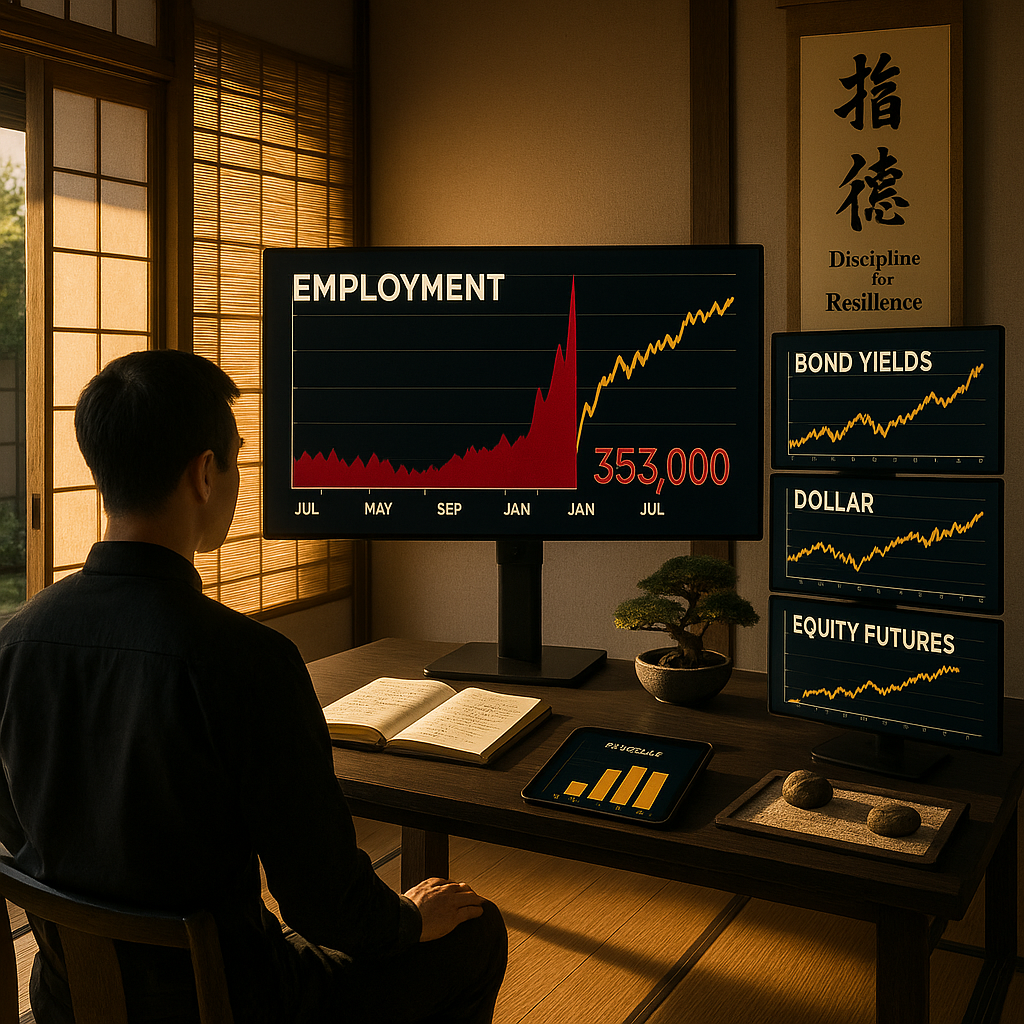
A disciplined trader analyzing real-time weather and water futures charts in a minimalist traditional Japanese home office. The space features tatami mats, sliding shoji screens revealing a tranquil garden, and a small bonsai tree on the desk. On the wall hangs a calligraphy scroll with the kanji for “Discipline.” Multiple monitors display weather maps, hydrological data, and annotated trading charts. Soft morning light streams through the paper doors, creating a calm but focused atmosphere. Close-up perspective highlights the trader’s precise hand movements as they jot down risk calculations in a trading journal. Photorealistic style with deep red and black accents for a sense of clarity and structured intent.



Leave a Reply