
Key Takeaways
-
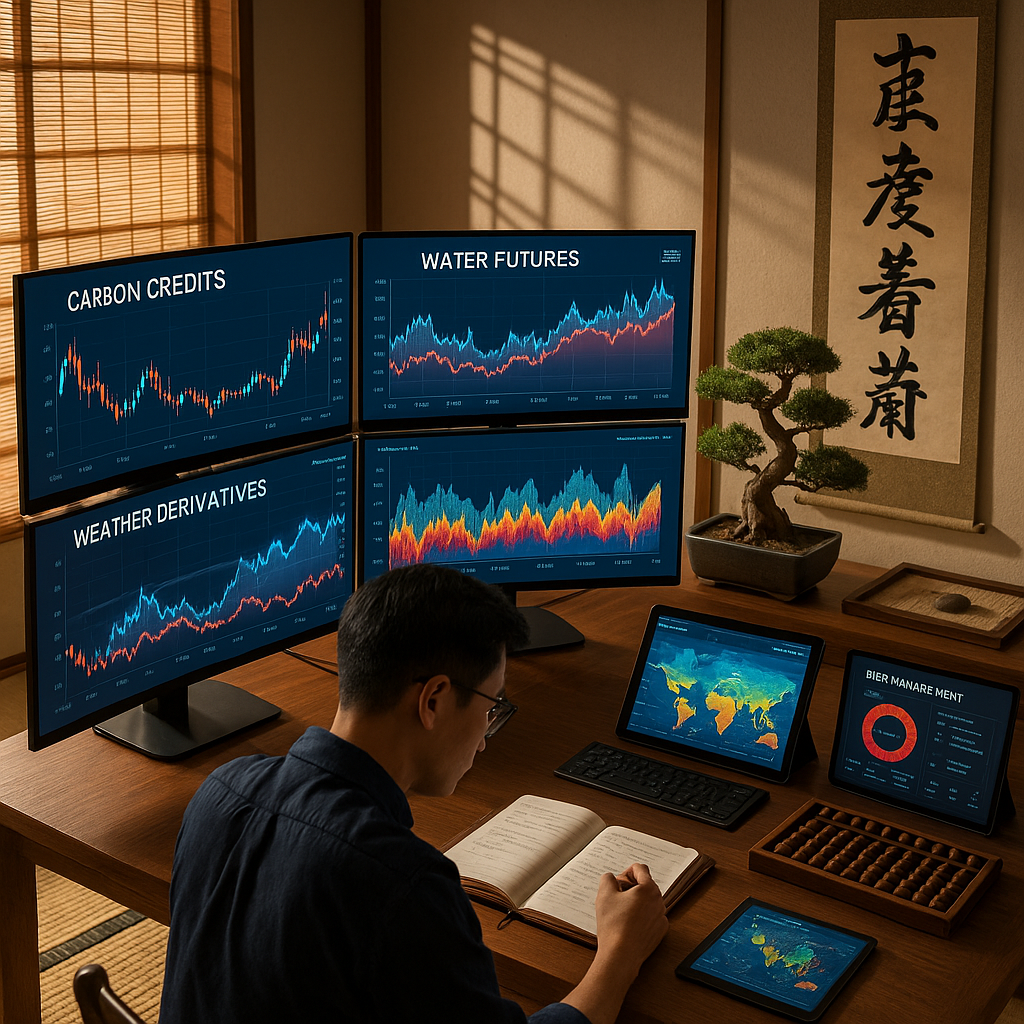
Resilience is the foundation of success in environmental markets. Traders here must navigate constantly evolving risks, unpredictable variables, and relentless emotional pressures. This case study reveals how disciplined practice and strategic thinking give traders the edge to overcome challenges such as basis risk, water futures volatility, and weather derivatives. These translate theory directly into real market results.
-
Transforming volatility into opportunity demands disciplined risk management. Effective environmental market traders rely on structured routines and clear protocols to turn chaotic price swings into calculated opportunities. This is especially critical when managing unpredictable factors like climate changes or resource scarcity, helping convert uncertainty into a strategic advantage.
-
Mastering basis risk is an exercise in relentless situational awareness. Basis risk (where futures contracts diverge from spot prices) requires traders to monitor both local and market-wide conditions continuously. Staying adaptive and grounded in up-to-date data helps ensure that strategies remain effective amid shifting market dynamics.
-
Emotional discipline consistently outperforms market noise. Top traders consciously counter emotional biases, maintain clarity under pressure, and view setbacks as learning opportunities instead of reasons for impulsive decisions. This emotional regulation is crucial for long-term success in volatile and value-driven markets.
-
Embracing innovative tools like water futures and weather derivatives enhances strategic capability. Adoption of modern risk-mitigation instruments, such as water futures contracts and weather derivatives, gives traders a powerful edge. These tools make it possible to hedge unique risks inherent in environmental assets, leading to increased resilience and market performance.
-
Continuous learning provides a lasting competitive advantage. The most successful traders approach every trade as an opportunity for deliberate practice. They systematically review outcomes, refine strategies, and seek diverse feedback, ensuring their skills evolve alongside the increasing complexity of environmental markets.
Resilience in environmental markets goes beyond mere toughness. It is the disciplined art of self-mastery amid uncertainty. In the pages ahead, we dive deeper into tactical frameworks and mindset shifts that elevate ordinary traders to exceptional performers in this demanding arena.
Introduction
Environmental markets stand as some of the most demanding frontiers for traders, challenging them to operate with precision and adaptability in a landscape shaped by climate dynamics, resource constraints, and rapid regulatory shifts. Here, every change in weather or policy requires swift adaptation, careful analysis, and unwavering discipline.
Success in these markets is not just about harnessing price trends or spotting short-term opportunities. The real test lies in mastering uncertainty. Maintaining composure, refining strategy, and embracing continuous growth in an environment defined by unpredictability.
This case study explores the tactical and mental strategies that disciplined traders use to excel. From leveraging structured risk routines and integrating innovative instruments, to addressing emotional bias and mastering evolving market conditions, we examine how top performers turn environmental market chaos into a crucible for personal and professional growth.
Stay Sharp. Stay Ahead.
Join our Telegram Channel for exclusive content, real insights,
engage with us and other members and get access to
insider updates, early news and top insights.
 Join the Channel
Let’s explore how resilience, anchored by disciplined practice and a commitment to self-mastery, separates successful traders from the crowd in this dynamic and high-stakes domain.
The Psychology of Trading in Environmental Markets
Navigating environmental markets requires far more than technical skill or pattern recognition. These markets are driven by intricate external forces (climate patterns, water cycles, policy interventions, and disruptive innovation). These dynamics introduce not only financial complexity, but also constant psychological strain.
Traders in carbon credits, renewable energy certificates, water futures, and weather derivatives must approach markets with a uniquely resilient mindset. Here, the stakes are elevated by the volatility of nature and the infancy of the markets themselves. As a result, mental preparation becomes as crucial as any analytical method.
Uncertainty and Decision-Making Under Pressure
Environmental markets expose traders to an ongoing storm of uncertainty. Policy decisions can shift without warning. Extreme weather can transform market landscapes overnight. New renewable technologies can quickly upend established valuations.
Such volatility triggers two key psychological responses. One is decision paralysis, where the trader hesitates and misses timely opportunities due to overwhelming variables. The other is impulsive action, reacting out of fear or stress instead of analysis and leading to costly mistakes.
The root of these responses is a deeply ingrained aversion to ambiguity. Human psychology favors known risks over the discomfort of the unknown. In environmental markets, however, many variables are not just uncertain but fundamentally unknowable: future drought patterns, regulatory surprises, or sudden technology breakthroughs.
To remain effective, resilient traders employ structured decision frameworks. They:
- Build scenario trees to map multiple possible futures and predefine responses
- Design decision triggers that activate regardless of emotional state
- Rely on robust risk management protocols that accept uncertainty as a core feature
These practices offer psychological stability, enabling traders to act decisively even when conditions shift rapidly.
Emotional Biases Unique to Environmental Markets
Unlike traditional markets, environmental assets evoke powerful personal values and beliefs. This intersection of mission and market can foster unique cognitive biases, distorting objectivity and leading to clear-cut errors.
One prevalent example is “mission alignment bias.” Traders deeply invested in environmental causes may stubbornly hold or add to positions aligned with their values (such as renewable energy certificates) even when data suggests a reversal or correction. This emotional attachment clouds judgment and overrides technical evidence.
Similarly, “catastrophe anticipation” can trigger overreactions to negative environmental news. When headlines announce devastating floods or droughts, traders may engage in panic selling or hurried buying, often before gathering comprehensive data.
Behavioral finance research identifies confirmation bias as another major pitfall in environmental trading. Traders naturally gravitate toward information that reinforces their views on climate trends or policy outlook, disregarding warning signs or contrary data.
To counter these tendencies, effective traders:
- Keep detailed journals to separate personal beliefs from market realities
- Participate in reviews with peers of diverse viewpoints
- Develop rule-based strategies requiring objective technical confirmations before any position change
- Integrate cooling-off periods after emotionally charged news
These measures foster a disciplined approach. They ensure personal convictions never override evidence-based trading.
Building Resilience Through Specialized Knowledge
Resilient traders understand that emotional discipline is fortified by continuous learning. Mastery in environmental markets demands a cross-disciplinary knowledge base, linking climate science, regulatory policy, technological innovation, and advanced analytics.
This foundation provides context for market behavior. For instance, a sudden surge in water futures prices makes more sense to traders who comprehend both meteorological models and local policy impacts. When volatility strikes, informed traders rely on their broad knowledge rather than knee-jerk reactions.
Stay Sharp. Stay Ahead.
Join our Telegram Channel for exclusive content, real insights,
engage with us and other members and get access to
insider updates, early news and top insights.
Join the Channel
Key pillars of this expertise include:
- Climate and meteorological modeling (and an understanding of their limits)
- Regulatory trends and their impact across local and global markets
- Technological developments in renewables and conservation
- Agricultural practices as they relate to water and carbon dynamics
- Weather and climate pattern analytics
Such depth not only improves decision-making, but also instills confidence. As a trader’s expertise grows, so does their ability to remain calm in the face of abrupt market moves or emotionally charged events.
Continuous education becomes a psychological stabilizer. By consistently pursuing new insights, traders foster a sense of control and growth, transforming volatility from a threat into an opportunity for learning and advancement.
This mentality leads directly into the structured routines and disciplines that top environmental traders employ to maintain both composure and competitiveness.
Developing Mental Discipline: Case Studies of Successful Environmental Traders
Learning from real-world successes, we see that elite environmental market traders build discipline and psychological strength through intentional daily practices, decision protocols, and collaborative approaches tailored to this dynamic sector.
Case Study 1: Carbon Credit Trader’s Routine for Emotional Regulation
A top-performing carbon credit trader consistently outmaneuvered competitors during the high-stakes rollout of the EU’s Carbon Border Adjustment Mechanism. Her achievement is rooted in a daily routine designed to manage emotion-driven risk in policy-heavy markets.
Her three-step approach includes:
- Pre-market regulatory review: Each morning she spends 30 minutes analyzing global policy developments, categorizing them by impact potential. This habit prevents emotional overreaction to breaking news and keeps her focused on the biggest drivers.
- Mathematical position sizing: Trades are sized according to a calculus that reflects regulatory certainty, not gut feeling. During periods of high ambiguity, position sizes are automatically smaller, protecting her discipline against market noise.
- Scenario planning: For every high-stake trade, she documents three outcome scenarios (best, worst, likely) and plans responses in advance. This foresight reduces snap decisions during chaotic market swings.
The results are commanding. While average carbon traders saw drawdowns of more than 30% during key EU policy shifts in 2022, she kept losses under 12%. More strikingly, she reported a notable drop in stress, enabling sharper, more opportunistic market moves when volatility spiked.
Case Study 2: Weather Derivatives Specialist’s Cognitive Framework
During the extreme climate volatility between 2018 and 2021, a veteran weather derivatives trader established a framework for “emotional decoupling” from disaster-driven headlines.
His method comprises:
- Technical-first approach: Always starting with technical and volatility analysis before reading weather news, to anchor his view in objective data.
- Quantitative impact scoring: Translating qualitative forecasts into data-driven severity and duration scores, ensuring consistent comparisons and actions.
- Contrarian journaling: Systematically building arguments against his existing positions daily, inoculating himself against confirmation bias.
- Visualization for stress-testing: Regularly visualizing worst-case scenarios and preplanning responses, so that no shock catches him off-guard.
When such preparation met reality during Hurricane Ida’s market disruption, he maintained position limits and clarity while others got swept up in panic. The result: a 23% outperformance versus peers, with steadier returns through tumultuous conditions.
Case Study 3: Water Futures Trader’s Team-Based Resilience System
A water futures trading desk faced the punishing droughts of 2020-2022 by creating an explicit system for psychological resilience at the team level.
Their framework includes:
- Deliberate cognitive diversity: Pairs of analysts with opposite thinking styles (analytical and intuitive) are assigned major positions, switching leadership roles as needed.
- Emotional self-assessment: Traders record their emotional state before major decisions, using high-stress scores as a signal to seek peer review rather than forge ahead solo.
- Assigned devil’s advocate: On each major consensus trade, one team member argues the other side, ensuring robust challenge to groupthink.
- Post-event psychological reviews: After market shocks, the focus is not only on profit and loss but also on how emotions and discipline shaped results.
This approach yielded resilience and outperformance, even at the height of market panic. Emotional discipline, strengthened by structured collaboration, made the difference as they systematically capitalized on overreactions and mispricings caused by fear in the broader market.
The common thread: psychological discipline is deliberately constructed. No trader leaves emotional control to chance; it is practiced, measured, and embedded in routines, whether individually or as a team. Such discipline is essential for the next challenge, successfully navigating the nuances of basis risk and the increasingly sophisticated tools underpinning environmental markets.
Conclusion
Thriving in environmental markets calls for more than analysis or fast reflexes; it demands a unique blend of discipline, self-mastery, and an insatiable appetite for growth. These markets are defined by the unpredictability of nature and the ever-changing landscape of policy, technology, and human behavior.
Top traders distinguish themselves by actively building psychological resilience. They establish structured routines, foster cognitive diversity, and embrace transparent self-review, turning every setback into deeper learning and sharper strategy. Their commitment to ongoing education across disciplines ensures they remain relevant and effective as the environment and markets evolve together.
In an era where environmental and financial uncertainty increasingly intertwine, the most formidable weapon is a disciplined mind. For those on the trading journey, the path forward is clear: cultivate habits as rigorously as strategies, invest in knowledge as deeply as in capital, and practice self-mastery as the ultimate edge.
Looking to the future, those who can blend adaptability, emotional intelligence, and methodical learning will not just survive in environmental markets; they will lead the transformation. The core challenge remains: Are you prepared to sharpen both your trades and your mindset for whatever tomorrow’s markets may bring? The journey of discipline and mastery is endless, but every step yields strength, insight, and the potential to shape both your fortune and the world itself.


Leave a Reply