
Key Takeaways
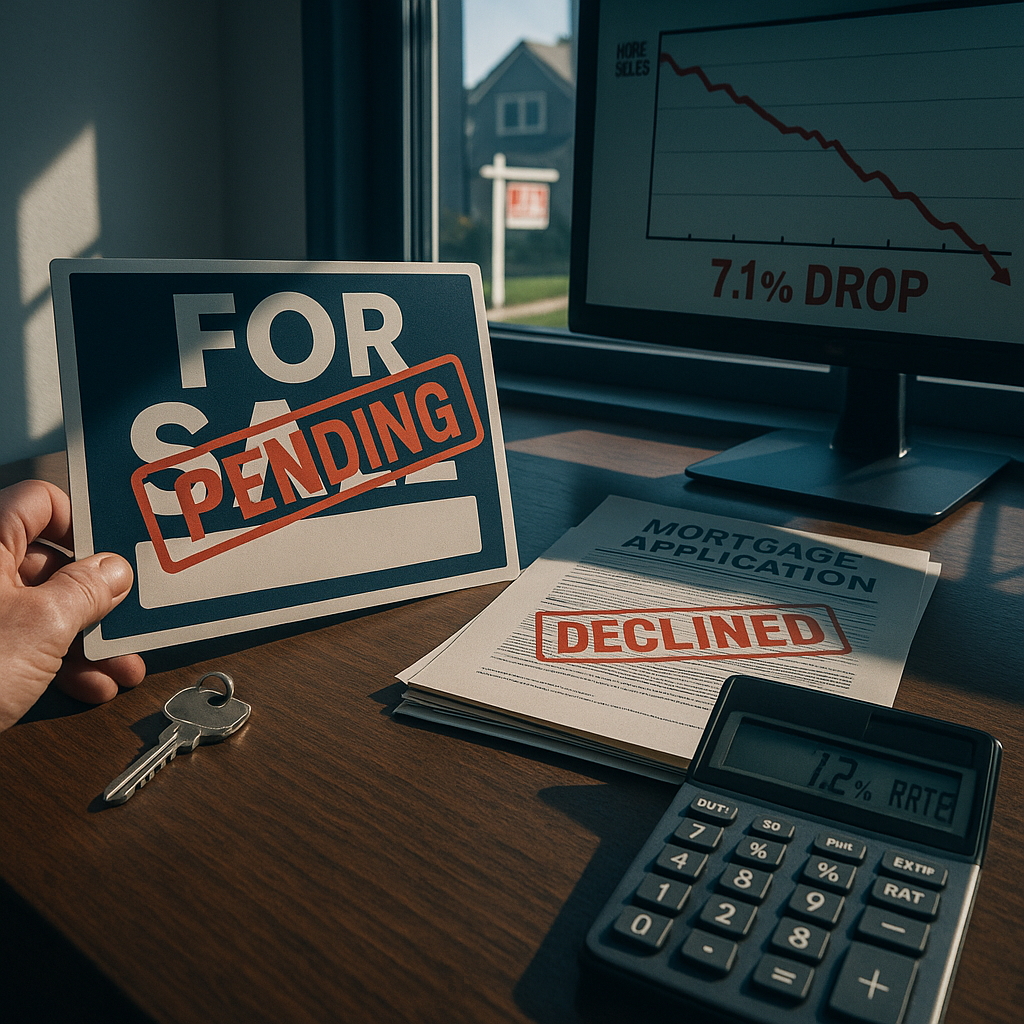
- Pending home sales dropped 7.1% in August, reaching their lowest level since April and falling well below analyst expectations.
- Rising mortgage rates, with the average 30-year fixed reaching 7.2%, are making home purchases less accessible.
- All US regions experienced declines, with the West reporting the largest decrease.
- Home prices remain high due to tight inventory, despite reduced demand.
- Economists expect further slowdown if mortgage rates remain above 7% through the fall.
Introduction
US pending home sales fell 7.1% in August, the National Association of Realtors reported today. This is the sharpest monthly decline of the year and signals a broad slowdown in the housing market. As 30-year mortgage rates climb to 7.2% and affordability becomes an increasing issue nationwide, more buyers are leaving the market. Home prices are staying high, even as demand softens.
Latest Housing Market Data
In August, pending home sales dropped 7.1% compared to July. This represents 2023’s largest monthly decline, according to the National Association of Realtors (NAR).
The Pending Home Sales Index fell to 71.8, missing analyst expectations of a 1% decrease and landing 18.7% lower than one year earlier.
All major US regions saw notable declines. The West recorded the sharpest decrease at 9.1%, followed by the South at 7.3%, the Midwest at 6.7%, and the Northeast at 5.9%.
Stay Sharp. Stay Ahead.
Join our Telegram Channel for exclusive content, real insights,
engage with us and other members and get access to
insider updates, early news and top insights.
 Join the Channel
Primary Market Drivers
Rising mortgage rates are the main reason for August’s significant decline. The average 30-year fixed mortgage rate exceeded 7.2% during the month.
Lawrence Yun, NAR Chief Economist, stated that the combination of high interest rates and home prices has made conditions challenging, especially for first-time buyers.
Inventory remains limited, with the number of homes for sale 14.1% below what was available a year ago. This further limits buyer options.
Impact on Housing Affordability
Monthly mortgage payments have increased by about $300 compared to the same period last year, based on data from Realtor.com.
Higher borrowing costs have slashed median-income household purchasing power by nearly 20% since January, leaving many potential buyers unable to afford homes in their desired communities.
Analysts highlight that these market conditions are especially tough for millennial buyers, who make up the largest group of first-time purchasers.
Market Response and Adjustments
To attract buyers in today’s tough environment, homebuilders are offering more incentives, such as rate buydowns and help with closing costs.
Real estate agents report seeing more buyers consider adjustable-rate mortgages or opt for smaller homes and different neighborhoods to remain within budget.
There has also been a rise in all-cash offers. These now make up 26% of home purchases, as buyers with substantial savings aim to avoid high interest rates.
Regional Market Variations
Western states face the most significant challenges, with California and Washington recording especially weak pending sales due to high average home prices.
The Midwest has shown relative resilience, supported by lower median prices and better inventory levels than coastal regions.
Despite the overall slowdown, southern states continue to attract new residents, helping maintain stable demand in certain metropolitan areas.
Conclusion
The steep decline in US pending home sales for August reflects the impact of rising mortgage rates and limited inventory on homebuyer demand, particularly among first-time and millennial buyers. Regional differences reveal how affordability in high-priced markets remains a key challenge. What to watch: future mortgage rate movements and inventory changes as both buyers and sellers adjust to a slower market environment.




Leave a Reply